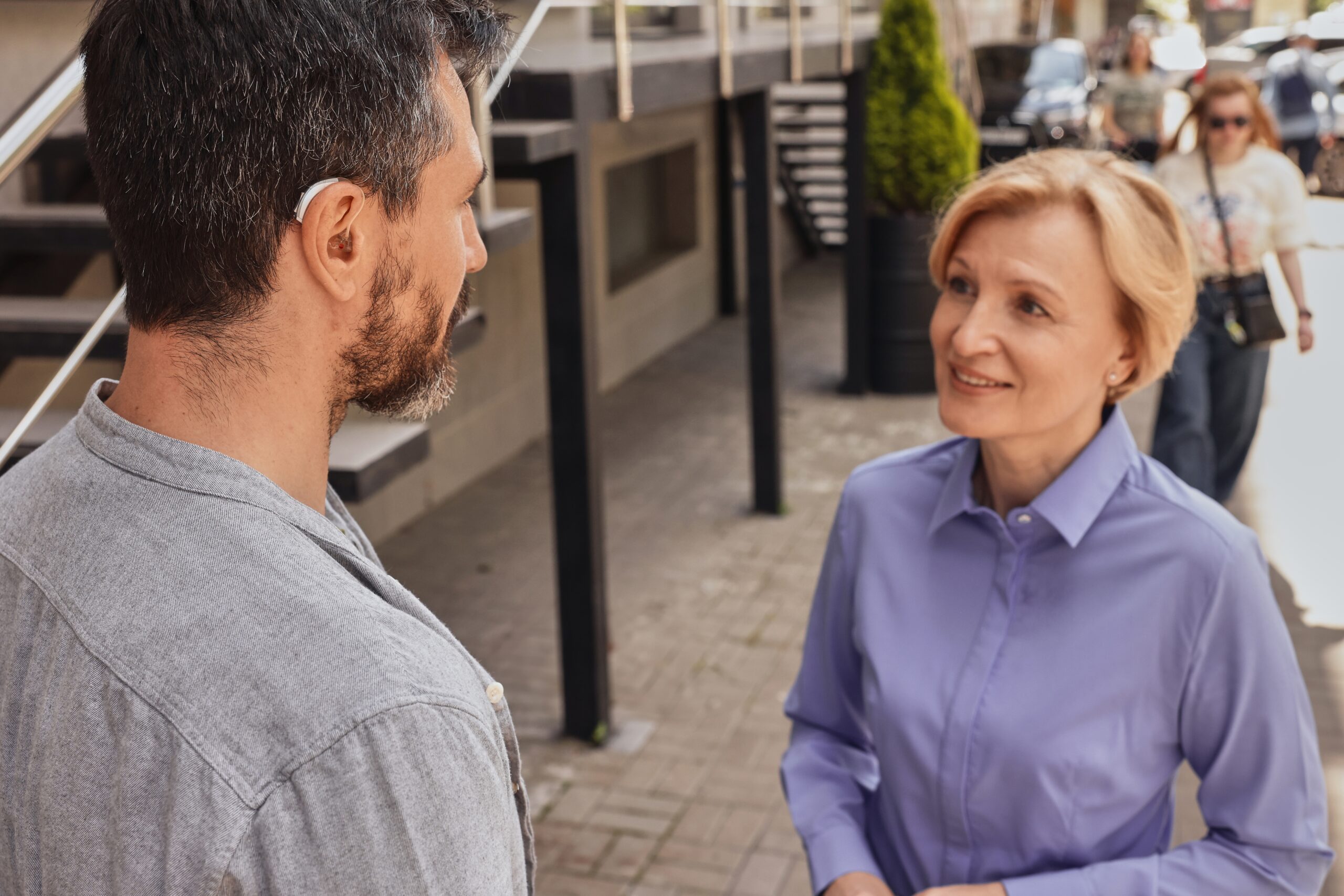
Group discussions in restaurants often become difficult to comprehend when room acoustics compete with your focus and hearing. Our practice can evaluate hearing in both quiet and noisy conditions to identify what makes these environments difficult. Once we determine the cause of difficult hearing, we can help you find personalized solutions.
Why Everyday Hearing Fails in Busy, Noisy Restaurants
Quiet rooms provide a favorable signal-to-noise ratio, meaning a speaker’s voice is much clearer than the sounds around it. Restaurants create the opposite situation. Overlapping chatter, piped music, kitchen clatter, and hard-surface reverberation mask speech, forcing the brain to expend immense cognitive effort to track conversation.
These communication barriers frequently indicate high-frequency hearing loss, central auditory-processing disorders, or age-related sensorineural changes. Attention, fatigue, dim lighting, and distance from the speaker may make it worse. Some people have normal results on a basic hearing test but still perform poorly on speech-in-noise testing. Communication breakdowns in loud restaurants should be professionally assessed even if one-on-one listening feels uncompromised.
Clinical Evaluation of High-Frequency Hearing Loss
We initiate evaluation by exploring challenging acoustic environments, acoustic trauma history, subjective tinnitus, prescription drug profiles, and unilateral ear changes.
Pure-tone audiometric evaluations measure the absolute quietest sounds audible across specific octave frequencies using air and bone conduction. In high-frequency hearing loss, the audiogram reveals a sloping configuration where hearing acuity drops progressively as pitch frequencies increase. Diagnostic evaluations may also integrate acoustic tympanometry to check middle-ear pressure alongside word-recognition testing to evaluate speech processing.
A quiet sound booth cannot replicate complex dining room acoustics, which makes clinical speech-in-noise testing especially informative. It calculates your ability to identify verbal phrases as competing background noise levels rise. In combination, these diagnostic metrics reveal whether communication hurdles involve audibility thresholds, speech discrimination, neural noise management, or mixed conditions.
The Role of Central Auditory Processing Disorders in Adults
Auditory processing disorders interfere with the brain’s ability to process and decipher acoustic signals arriving from the ears. A patient’s ears may demonstrate normal pure-tone sensitivity, but their central processing system struggles to separate background babble, distinguish consonant sounds, or follow swift discussions. We first evaluate peripheral hearing and then determine whether an individualized auditory-processing test battery or referrals to other professionals are appropriate.
Actionable Listening Tips for Noisy Social Settings
Small changes can improve the signal reaching your ears and provide clearer visual cues. When planning to dine out, select restaurants with calmer atmospheres or arrange reservations during off-peak hours. Restaurants featuring plush booths, wall acoustic panels, heavy drapery, carpeting, and sound-dampening materials provide superior listening compared to open rooms with reflective surfaces.
In-venue communication guidelines:
- Ask host staff for a quiet table distanced from kitchen traffic, bar noise, audio speakers, and loud group tables.
- Position your chair against a perimeter wall to diminish competing auditory chatter behind your head.
- Position yourself to directly face companions under bright lighting to enhance facial comprehension.
- Minimize the physical gap separating you and the person speaking as much as reasonably possible.
- Direct your better-performing ear toward the companion you most need to understand.
- Instruct conversational partners to reword missed phrases instead of repeating the entire sentence verbatim.
- Clarify critical details explicitly instead of nodding along or pretending to catch the message.
- Allow yourself a short listening respite when auditory concentration starts to feel drained.
- Encourage friends to enunciate clearly while maintaining an even, normal conversational tempo.
- Yelling distorts natural speech formants and rarely makes spoken words easier to decipher.
Assistive Listening Technologies for Noisy Environments
Determining the proper hearing technology hinges on the underlying disorder, everyday listening environments, and whether peripheral hearing loss is diagnosed. Professionally fitted hearing aids may use directional microphones, digital noise reduction, and dedicated restaurant programs to emphasize speech from the front and reduce some competing sound. Realistic expectations are vital, since even advanced hearing devices cannot completely erase background conversational chatter.
Wireless remote microphones provide the most effective enhancement to real-world signal-to-noise ratios. Clipped near the speaker’s mouth or set nearby, the transmitter sends voice signals wirelessly to matched hearing aids or a receiver. This reduces the effects of distance and surrounding noise.
Further practical hearing technology options include:
- Portable table microphones for managing multi-speaker dinner conversations
- Telecoils or hearing-loop systems in equipped venues
- Smartphone speech-to-text or live-captioning applications
- Earbuds or hearables with compatible assistive-listening features
- Acoustic sound-meter apps and dining review directories that score restaurant noise
Our team can compare these systems, verify device compatibility with your hearing aids, and provide comprehensive training on their use.
How Can a Doctor Help with Hearing in Loud Places?
Clinical hearing evaluations progress the diagnostic process past the typical assertion that hearing is adequate in quiet. We assess the specific acoustic settings, speaker dynamics, and volume levels that disrupt your hearing to administer targeted evaluations. Clinical evaluation commonly integrates pure-tone audiometric testing, middle-ear analysis, word recognition, and speech-in-noise measures. Dedicated central auditory-processing testing will be scheduled if your history and primary diagnostic testing indicate central pathway issues.
Hearing changes that present abruptly, affect only one side, or progress rapidly necessitate consultation with an ear, nose, and throat physician. Comprehensive clinical care targets the physiological roots of hearing difficulties rather than simply writing them off as bad restaurant acoustics.
Request an Audiology and Hearing Evaluation Today
If dining in loud spaces leaves you feeling isolated, fatigued, or guessing at missed speech, contact us to schedule a thorough hearing evaluation. Our clinical team will determine the best strategies to improve your hearing in noisy environments through custom hearing-aid programming, remote microphones, or targeted auditory rehabilitation.
Get in touch with our team to request an appointment and rediscover confident, stress-free restaurant conversations.